A chat app for iPhone with no account and no sign in.
Get it on the App StoreIt is free to download, and it asks you for nothing.
The rest of what it does.
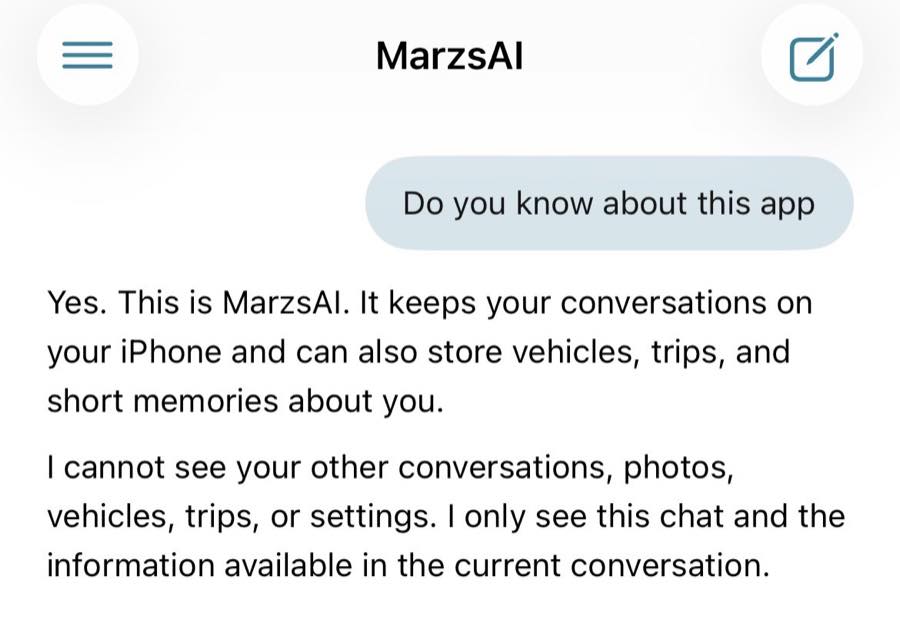
It is a chat app, and it answers questions the way you would expect. It also keeps things for you: your conversations, a short memory of what matters, your cars, your trips. Most chat apps are a front end for a model somebody else runs, and a front end has nowhere to keep any of that.
Your conversations stay on the phone.
Every thread is stored in a database on the device itself. There is no copy on our server and no account to sync one to. Deleting the app deletes them, and there is no way to get them back afterwards.
Answering a question means sending that question out. Where your messages do go, below, says exactly where and what goes with them.
What it remembers goes through your iCloud, not a server.
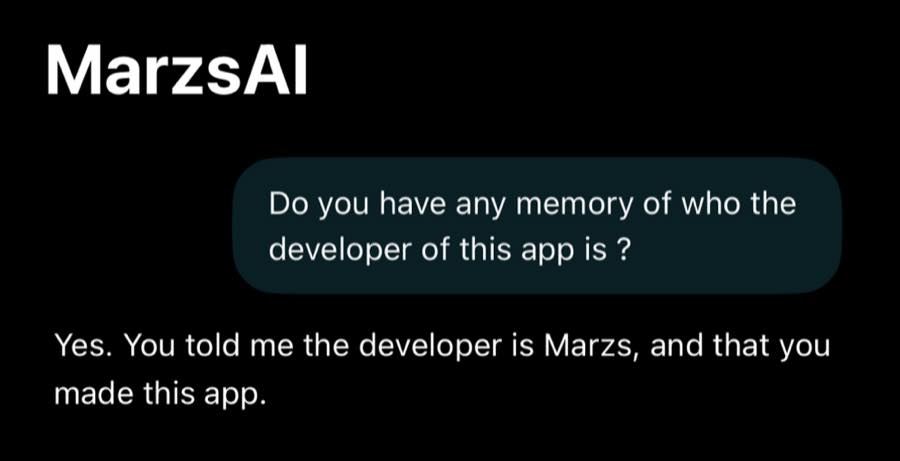
The app keeps a short list of things worth remembering between conversations. That list lives on your device and, if you have iCloud on, in your own iCloud account. It is why the list follows you to another device, and it is why there is no copy of it here to read. It counts against your iCloud storage rather than against anything of ours.
You can read the whole list, change any line and delete any of it, on one screen.
A VIN is looked up, not guessed.
Type the seventeen characters off a windscreen and they are decoded against the government vehicle database. The year, make, engine and trim come back as a lookup. Ask a language model the same question and it will answer just as confidently with the wrong engine, and nothing in the reply will tell you which one you got.
Trips are built from photos you already took.
Pick the days. It reads the photos already on your phone, along with the place and time the camera recorded for each one, and holds them together as one trip. Place names are worked out once and then kept, so a trip still knows where it went when you open it with no signal.
Nothing is uploaded, nothing in your camera roll changes, and you never have to remember to open an app while you are driving.
There is no account, so there is nothing to sign in to.
No sign up, no password, no email. The app opens and you type. The request that goes out to be answered carries no name and no account. It carries a random number that stands for your copy of the app, so the messages can be counted, and that number is not you and not your device.
Where your messages do go.
To answer a question, the app sends it to a company that runs the model. That company is not us. Which one answers can change, so this page does not name one. Anything you have saved to memory goes out with the message, because a reply can only use what it has been told. Nothing else does: no adverts and no tracking.
The privacy policy says all of this in full, including how long things are kept.
What has shipped, and where it is going.
One person builds this, most days. The first list is what is in the build behind the link above, described specifically enough that you can check it once you have the app. The second list has no dates on it on purpose.
Reminders
Say it in an ordinary sentence. The app shows you the date it read out of it before it saves anything, so a misread is yours to correct rather than yours to discover later.
Trips
Built from the photos already on your phone across the days you pick, with the place and time the camera recorded. Nothing is uploaded and nothing in your camera roll changes.
Vehicles
A VIN is decoded against the government vehicle database, so the year and engine are looked up rather than guessed at. Your own hours are counted as hours instead of converted to money at a rate nobody checked.
Memory you can edit
The whole list of what it knows about you is on one screen. Change any line, delete any of it, and see where the line falls between what is being sent and what is not.
One place for what you have kept
Conversations, vehicles, trips, reminders and memory behind one control, and each of them appears only once you have one.
An assistant that knows what the app can do
It is told the app's real capabilities and its real limits, generated from the same code the screens are, so it offers what exists instead of describing a screen that does not.
Where it is going
No dates on this half, because a date here is a promise and these are directions. Anything below moves up once it is real.
More things worth keeping
The same shape as vehicles and trips, for other things people are already tracking badly somewhere else.
Less distance between saying and saved
Most of what the app does still takes more taps than the sentence that described it.
Useful with no signal
Everything already on the phone should be readable when nothing is reachable.
Ask for something.
If the thing you want is not there, say so here. It goes into a list one person reads, and it is read rather than counted. An email address is optional, and an address you leave is only ever used to write back to you.
A bug, something confusing, or a request to delete data goes to the support page instead, where there is a real address and a person on the other end of it.